
Shared mobility in Valencia: Valenbisi, mopeds, scooters and ride-hailing (2026 guide)
Valencia is flat, compact and criss-crossed with bike lanes: a dream for getting around without a car. But its shared-mobility scene has one big surprise in store if you arrive from London, Paris or Madrid. Here is the full 2026 picture: what exists, what does not, what it costs and what the law says.
The surprise: no shared e-scooters
Let us start with the twist. Unlike Madrid or Barcelona, Valencia has never allowed free-floating electric scooters, the kind you unlock in the street with an app. The city explicitly excluded dockless scooters (patinetes sin base) from its shared-mobility plan. Back in 2018, Lime rolled out 200 scooters without permission: the local police removed every last one within a week.
In practice, if you want to ride a scooter in Valencia:
- either you own your own, in which case mind the new 2026 rules (see below);
- or you rent one from a shop, by the hour or the day (expect around 10 to 15 € per hour), from a fixed base, not free-floating.
The only motorised two-wheeler that is genuinely free-floating in Valencia is the moped. More on that now.
Valenbisi, the real shared-mobility reflex
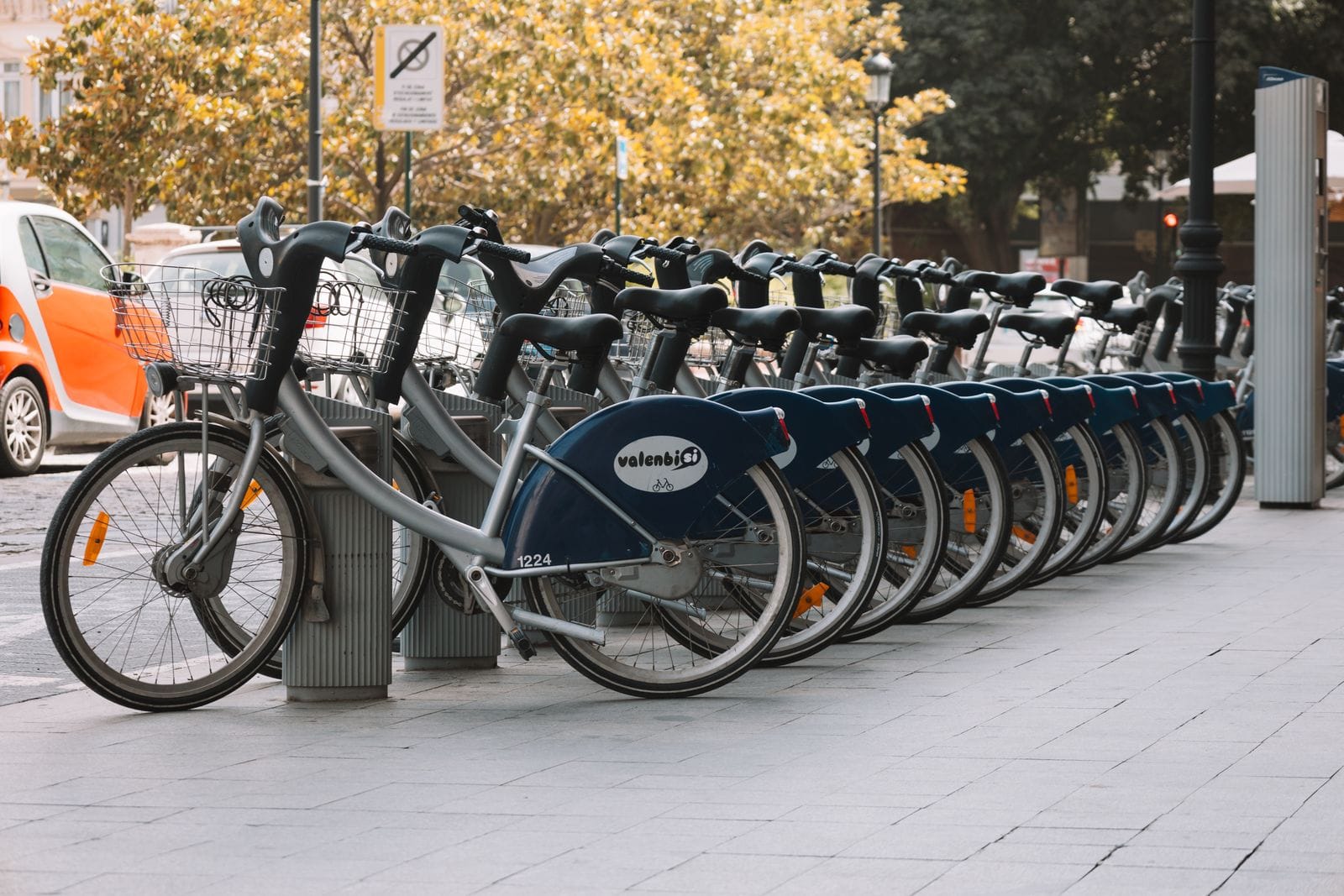
Valencia's shared-mobility champion is the municipal bike scheme Valenbisi: 2,750 bikes across 275 stations city-wide. Pick up at one dock, drop off at another.
- Annual pass: €29.21 (about €2.40/month). Weekly pass (to try it out, or for visitors): €13.30. Reduced rates: €24 for over-55s, €20 for long-term jobseekers (35 and over).
- The first 30 minutes of every ride are free (included in the pass). Then €0.52 from 30 to 60 min, and €2.08 per extra hour.
- Tip: almost every urban ride fits under 30 minutes, so day to day Valenbisi costs next to nothing.
Everything runs through the Valenbisi app: pass, station map, available bikes. The city's trump card is the Turia Garden: the former riverbed, turned into a green corridor of nearly 9 km with a continuous bike path crossing Valencia from the Bioparc to the City of Arts and Sciences, without a single car. Cycling heaven.
Shared electric mopeds
Moped sharing, on the other hand, is alive and free-floating (pick up and leave the moped anywhere within the service area). Three operators share Valencia:
- Yego: around €0.26/min, with cheaper minute bundles (bonos).
- Acciona: present in Valencia, around €0.19 to €0.31/min depending on the plan.
- Cooltra: around €0.35/min without a bundle.
A helmet is provided (in the top case) and insurance is covered by the operator. Licence-wise: these are electric 125 cc equivalents, so you need a valid licence, either a motorbike licence (A1, A2 or A) or a car licence held for at least 3 years (Spain's rule for riding a 125). If you moved with a non-Spanish licence, check our guide to exchanging your driving licence first. Sign-up happens in the app with a photo of your licence, minimum age usually 18.
Ride-hailing and taxis: the apps that get you a car
Good news: contrary to popular belief, all the big apps work in Valencia:
- Bolt: yes. The platform launched its ride-hailing service in Valencia (and Alicante) in early 2026, with a fleet of electric cars and wheelchair-accessible vehicles.
- Cabify: yes, the most established ride-hailing (and taxi) app in town.
- Uber: yes, and very much present, with classic Uber cars (VTC) as well as official taxis depending on the moment.
- FreeNow: yes, to hail an official taxi from your phone.
- For pure taxis, the national app PideTaxi also works in Valencia, as do the local radio-taxi numbers. Taxis are white, run an official meter, and there is a flat rate to and from the airport.
In short: Bolt, Cabify or Uber for a car with a driver; FreeNow or PideTaxi for an official taxi.
The 2026 rules you absolutely need to know
2026 changes the game for e-scooters and personal mobility vehicles (PMVs). If you ride your own:
- Insurance compulsory since 2 January 2026: third-party liability cover is now required, as for a car. Riding without it means a €600 to €1,000 fine and your scooter impounded.
- DGT registration: every scooter must be entered in the DGT's register of light personal vehicles, with a visible identifier.
- Minimum age: 16.
- Helmet: not compulsory for light PMVs (type A) but strongly advised; compulsory for the more powerful ones (type B), with a €200 fine at stake.
- Where to ride: like bikes, on bike lanes and the road. Forbidden on pavements and pedestrian areas (fines around €200, up to €600 depending on the case). Speed capped at 20 km/h on road-level bike lanes, 15 km/h on pavement-level ones.
- One rider only, no phone or earphones, and drink-riding checks as behind the wheel.
The good news: with shared mopeds or shop rentals, insurance is the operator's problem, nothing for you to manage.
Our practical tips
- The app to install first: Valenbisi if you are settling in (the best value in the city), Bolt or Cabify for ride-hailing, plus your moped app if you have the licence.
- Make the most of the Turia: flat, partly shaded, car-free. The backbone of cycling in Valencia.
- Pedestrian zones: the historic centre (Ciutat Vella, around the cathedral and the Central Market) is largely pedestrianised. Get off and walk: the police do fine people.
- The classic trap: riding a scooter on the pavement. It is forbidden and enforced. Bike lanes are everywhere: use them.
- If you buy a scooter: check it is type-approved, insure it and register it with the DGT before riding. Compulsory since 2026.
What does it cost? City centre to Malvarrosa compared
Typical ride of about 4.5 km, from Plaza del Ayuntamiento to Malvarrosa beach:
| Mode | Price per trip | Worth knowing |
|---|---|---|
| Valenbisi (bike) | ~ €0 | Free under 30 min with the pass (€29.21/year). About a 20-min ride. |
| Metro/tram + EMT bus | ~ €1.50 | Tram L4 or L6, or bus to the beach. The cheapest option. |
| Shared moped (Yego, Acciona, Cooltra) | ~ €3.50 to €4 | About 13 min. Licence required, helmet provided. |
| Ride-hailing (Bolt, Cabify) | ~ €8 to €13 | Depending on time and demand. |
| Taxi | ~ €10 to €14 | Official meter, daytime rate. |
| Shared e-scooter | Not available | Does not exist in Valencia. |
Indicative July 2026 prices, varying with time and demand. The everyday winner is still the Valenbisi bike, unbeatable once you have the pass.
To dig deeper, see our guides to getting around Valencia and the cost of living.
Sources
- Valenbisi: official fares
- elDiario: shared mobility approved in Valencia (mopeds yes, dockless scooters no)
- El Español: Valencia without rental scooters
- RACE: e-scooter rules in Valencia
- Valencia Bonita: the new 2026 rules (insurance, register)
- Northleg: taxi apps in Valencia
- Valencia Plaza: Bolt launches ride-hailing in Valencia (2026)
Information verified in July 2026. Fares, zones and rules change: always confirm with the official source before you ride. Verified by our editorial team. This article was prepared with the help of AI, then cross-checked, fact-checked and edited by our newsroom, which takes full editorial responsibility, in line with the EU AI Act. Spotted an error? Write to us: we fix it. How we work.
Le Livre blanc de l'expat à Valencia
NIE, empadronamiento, fiscalité, école, logement : tout l'essentiel pour s'installer, réuni dans un guide PDF. Laisse ton e-mail, on te l'envoie.
🎉 Et voilà ! Ton Livre blanc de l'expat s'ouvre ici :
Ouvrir le Livre blancDernière étape pour rejoindre l'aventure : confirme ton inscription dans l'e-mail qu'on vient de t'envoyer.