
Where can you see flamingos at sunset on the Costa Blanca?
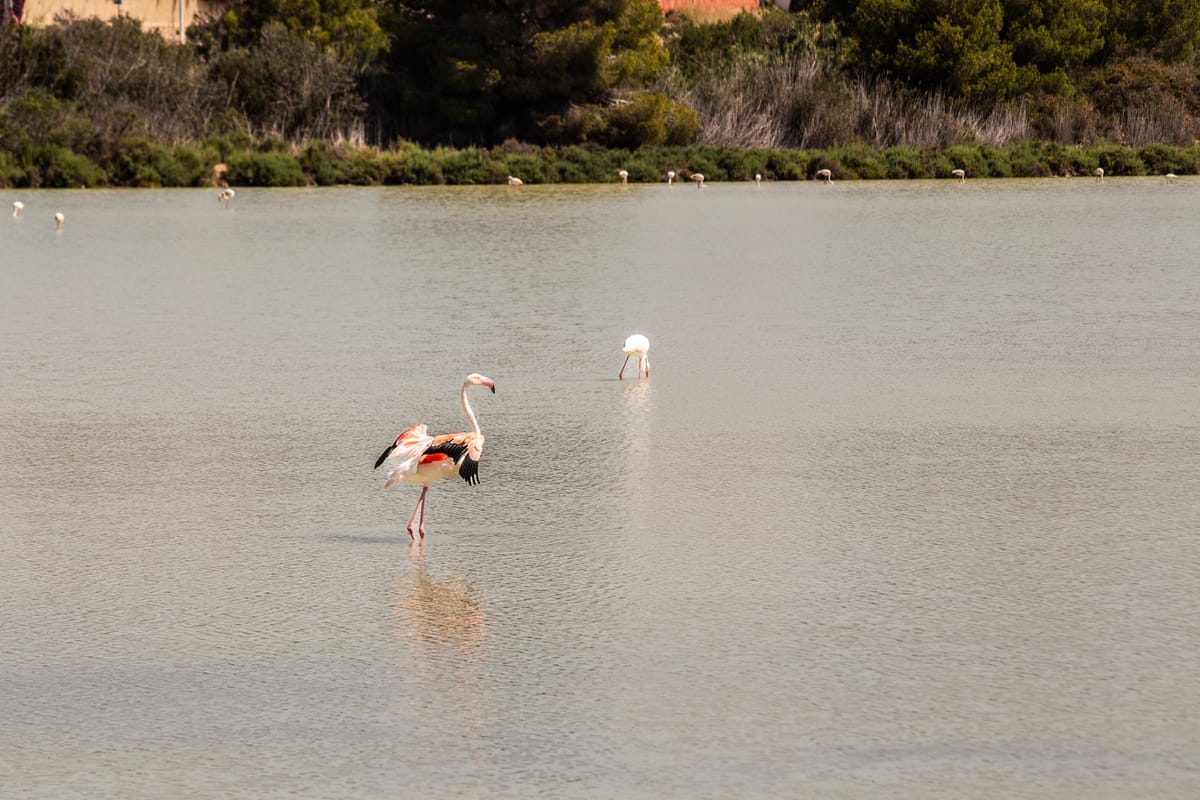
The best pairing of sunset and flamingos on the Costa Blanca is the Salinas de Santa Pola Natural Park: flamingos are visible there almost all year, often straight from the road, and the Torre del Tamarit viewpoint is free to reach at any hour. The El Fondo Natural Park, between Elche and Crevillente, is the richest wetland for birdlife in the province, but its one dedicated birdwatching circuit only runs on Saturday mornings, by reservation, which is no good for a sunset. And Torrevieja's Laguna Rosa is mainly a colour spectacle, not really a flamingo site. Here is how to choose depending on what you are after.
Which wetland is best for flamingos at sunset?
On the southern Costa Blanca, three sites compete for the title, but they are not in the same league. The Salinas de Santa Pola Natural Park is home to a flamingo population that can reach around 8,000 birds in the breeding season (source: Wikipedia, "Parque natural de las Salinas de Santa Pola", and exploraturuta.com, which places that period between April and August). The birds are on show almost all year, often visible straight from the N-332 itself. The El Fondo Natural Park, by contrast, is above all a sanctuary for the full range of birdlife (more than 170 species recorded, according to several specialist ornithology sources), with flamingos mostly frequenting the tail end of the Poniente reservoir, on the birdwatching circuit that is the most restricted for opening hours (source: todoelche.com). As for Torrevieja's Laguna Rosa, its colour comes from a bacterial phenomenon rather than a strong flamingo presence: the birds are mostly seen at the neighbouring La Mata lagoon, not in the pink lake itself.
El Fondo Natural Park: the largest wetland, but not built for sunset?
El Fondo (or El Hondo, spread across the municipalities of Elche, Crevillente and San Felipe Neri) has been a natural park since 12 December 1988 and has featured on the Ramsar list of wetlands of international importance since 1989, covering around 2,387 hectares (source: Wikipedia, "Parque natural de El Hondo", cross-checked with the official site parquesnaturales.gva.es). It is a former network of irrigation basins that has become a refuge for herons, ducks, stilts and, occasionally, flamingos.
The thing to know before heading there for a sunset: the ruta roja, the birdwatching route that runs alongside the Poniente and Levante reservoirs (where flamingos are most often reported), operates only on Saturday mornings, by arranged visit, from 8:30 to 11:30am, according to the park's official site (parquesnaturales.gva.es). In short, that circuit cannot be done in the evening. The other routes, however (the ruta verde towards the Laguna del Rincon and the Saladar, and the ruta amarilla near the information centre), stay open every day, at any time of day, even when the visitor centre is closed, which does leave the option of still being there at sunset, with no guarantee of coming across flamingos on that stretch. The visitor centre itself opens Monday to Friday from 9am to 2pm, Saturday from 12 noon to 2pm, and Sunday and public holidays from 9am to 2pm (source: parquesnaturales.gva.es), with free parking on site. No official information mentions an entry fee for the park's trails.
The Salinas de Santa Pola: the best sunset and flamingo combo?
This is the most reliable site for pairing the two. The Salinas de Santa Pola Natural Park covers around 2,470 hectares and was declared a natural park on 27 December 1994 (source: Wikipedia, "Parque natural de las Salinas de Santa Pola"). Unlike El Fondo, there is no closed, reservation-only circuit for watching flamingos: they are often visible from the road that runs alongside the salt pans, and the best vantage point for sunset remains the Torre del Tamarit, an old watchtower at the entrance to the albufera, reachable by car via the N-332 heading towards Guardamar, with parking on site. In autumn, the pans with the highest salt concentration take on an intense pink hue that blends with the colours of the setting sun (source: exploraturuta.com). Bring binoculars if you want to see the flamingos up close: the densest colonies stay in the more inland pans, not right by the roadside.
And Torrevieja's Laguna Rosa: are there any flamingos?
Not really, and this is the most common misunderstanding. The Laguna Rosa is part of the La Mata and Torrevieja Lagoons Natural Park, and its pink colour comes from a biological phenomenon: a bacterium (Halobacterium) and a microalga (Dunaliella salina) that release a reddish pigment to survive in water with a very high salt concentration (source: lavegabajadelsegura.com). That extreme salinity is precisely what makes the Torrevieja lake inhospitable to flamingos, which gather instead at the neighbouring, less salty La Mata lagoon. Flamingos are at their most numerous in the breeding season, in spring, but remain visible for a good part of the year. For the most intense pink colour of the lake itself, however, you need to come in summer, in July and August, ideally at the hours when the sun beats down hardest, which does not make it the best candidate for a classic sunset. Access to the edges of the lagoon is free, swimming is banned (private salt-extraction operation), and there is no entry fee for the natural park or its trails.
How do you choose your spot depending on what you want?
| Site | Status | Flamingos | Sunset |
|---|---|---|---|
| Salinas de Santa Pola | Natural park, 2,470 ha, Ramsar, since 1994 | Up to ~8,000 birds in the breeding season, visible almost all year | Torre del Tamarit, free access by car, parking on site |
| El Fondo Natural Park | Natural park, 2,387 ha, Ramsar since 1989 | Mostly present on the ruta roja, Saturday mornings 8:30-11:30am by reservation | Green/yellow trails open every day during the daytime, away from the flamingo circuit |
| Laguna Rosa (Torrevieja) | La Mata and Torrevieja Lagoons Natural Park | Few on the pink lake, more at the neighbouring La Mata lagoon | Free access, but the most intense colour comes at midday in summer, not at sunset |
Our tips for a successful outing?
- For a guaranteed sunset with flamingos: head straight to the Salinas de Santa Pola, to the Torre del Tamarit, in the late afternoon.
- For El Fondo: if you really want the ruta roja and its flamingos, book your place for a Saturday morning (966 67 85 15 or parque_elhondo@gva.es); for an evening walk, go for the ruta verde or ruta amarilla instead, bearing in mind that flamingos are not guaranteed there.
- Bring binoculars: at all three sites, flamingos often keep well away from the paths, in the more inland pans and basins.
- Respect the sites: these are protected spaces (Ramsar) where you stay on the marked trails and do not disturb the colonies.
Frequently asked questions
Where are you sure to see flamingos at sunset on the Costa Blanca?
At the Salinas de Santa Pola, from the Torre del Tamarit. Flamingos are visible nearly year-round, with colonies of up to around 8,000 birds in the breeding season (April to August, per exploraturuta.com), and access is free at any time.
Can you see flamingos at sunset in the El Fondo Natural Park?
Not guaranteed. The dedicated birdwatching route (the ruta roja, along the Poniente and Levante reservoirs) only runs on Saturday mornings, from 8:30 to 11:30am, by reservation, according to the park's official site. Other trails stay open in the evening, but there is no guarantee of flamingos there.
Are there flamingos in Torrevieja's Laguna Rosa?
Very few. The extreme salinity pushes them to the neighbouring La Mata lagoon instead. The Laguna Rosa is mainly a colour spectacle, at its most intense in summer around midday.
Do these sites charge an entry fee?
No entry fee is mentioned in any source consulted for the trails or viewpoints at these three wetlands. Only the guided birdwatching circuit at El Fondo requires a reservation.
Sources
parquesnaturales.gva.es (El Fondo Natural Park), es.wikipedia.org (Parque natural de El Hondo, Parque natural de las Salinas de Santa Pola), todoelche.com, exploraturuta.com, lavegabajadelsegura.com.
Information verified in July 2026. The Daily Costa Blanca is an AI-assisted publication with human editorial review and responsibility.
Le Livre blanc 2026 de l'expat
NIE, empadronamiento, fiscalité, école, logement : tout l'essentiel pour s'installer, réuni dans un guide PDF. Laisse ton e-mail, on te l'envoie.
🎉 Et voilà ! Ton Livre blanc 2026 de l'expat s'ouvre ici :
Ouvrir le Livre blanc 2026Dernière étape pour rejoindre l'aventure : confirme ton inscription dans l'e-mail qu'on vient de t'envoyer.
Réagis à cet article