
Driving a car on the Costa Blanca: licences, registration, low-emission zone, parking and charging
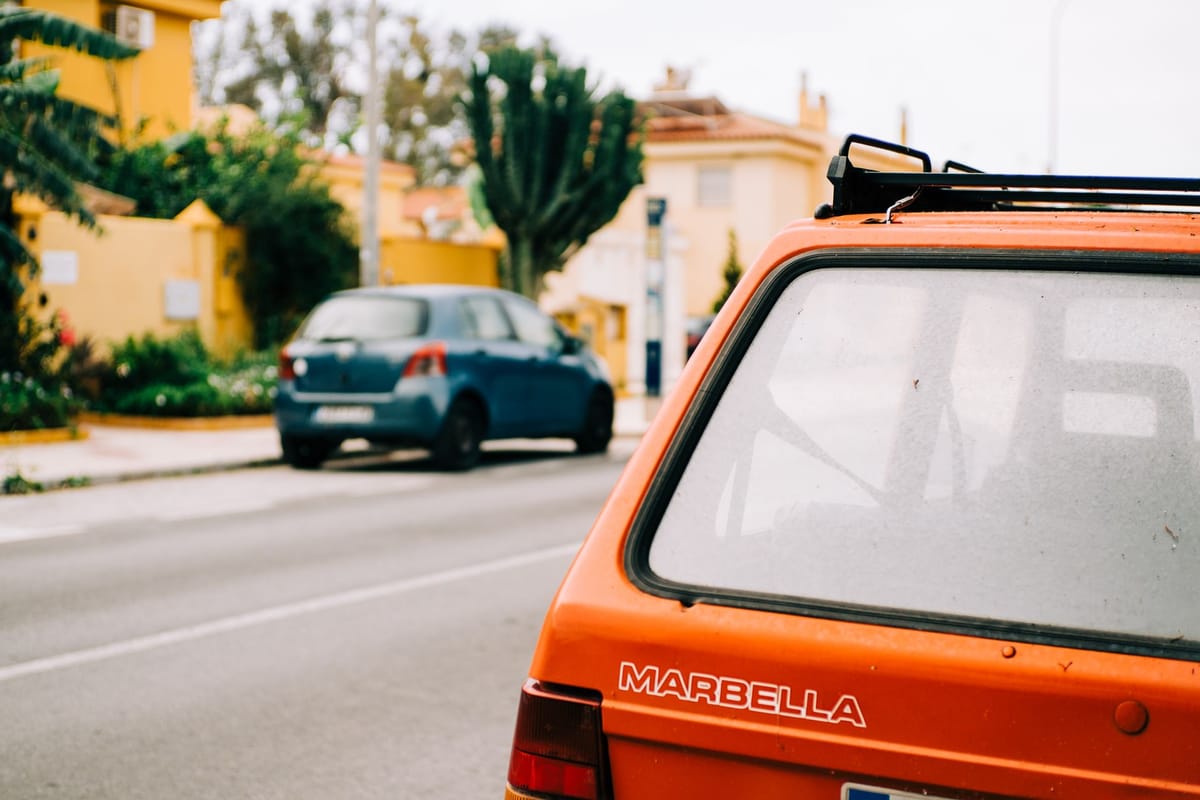
On the Costa Blanca a car is rarely a luxury and often a necessity: between the sprawling urbanizaciones, the inland villages and the coves off the TRAM lines, plenty of newcomers drive every day. If you arrive with a car on foreign plates, or plan to buy one here, there is a short administrative trail to know and a couple of zones you must not drive into without thinking. Licences, registration, the Low-Emission Zone, parking and EV charging: here is the complete 2026 guide.
Your licence: the rules depend on your nationality
Whether your licence stays valid, and whether you need a test, depends on where it was issued:
- UK licence: valid for driving on arrival, but you may only use it for six months from becoming resident. Within that window you can exchange it for a Spanish licence with no test under the UK-Spain agreement; miss the window and only the full Spanish exam remains.
- US licence: fine for short visits (an International Driving Permit is recommended), but there is no exchange agreement, so once resident you must pass the full Spanish theory and practical test.
- Irish / EU licence: valid as long as it is in date, with no test. Register it with the DGT once resident; a formal exchange only matters when it expires.
We cover every case in detail in our guide to exchanging your driving licence in Spain.
Re-registering a foreign-plated car
While you are a tourist or non-resident you can drive on your foreign plates. But once you become a resident, you must re-register (matriculación) the car in Spain, and quickly: the deadline is short, of the order of 30 days after you gain residency. Driving on foreign plates as a resident risks a fine.
The route, in short:
- Pass the Spanish ITV (roadworthiness test). A home-country MOT or equivalent does not count, you must do the ITV here.
- Gather the papers: the foreign registration document and Certificate of Conformity (COC), your NIE, and proof of address.
- Pay the one-off registration tax (impuesto de matriculación, based on CO2 emissions), then the annual road tax (impuesto de circulación) set by your town hall.
Allow two to three weeks with a complete file. Many people use a gestoría to avoid the back-and-forth.
The Alicante Low-Emission Zone: milder than elsewhere
Don't expect the Madrid or Valencia machine here. The Alicante Low-Emission Zone (ZBE) has run since January 2025, but on a deliberately cautious model. It is split into three rings, and only ring I, the Casco Antiguo (the old town), applies permanent restrictions. You get in with a DGT environmental sticker (0, ECO, C or B), plus residents, garage owners and authorised vehicles. More than 70 number-plate cameras control the accesses. The fine is €200 (€100 if you pay within 20 days).
The useful reminder on the DGT stickers:
- 0 (blue): electric, hydrogen, plug-in hybrids with 40 km+ range. ECO: hybrids, gas. C (green): petrol from 2006, diesel from 2014. B (yellow): petrol 2000-2005, diesel 2006-2013.
- No sticker (petrol before 2000, diesel before 2006): these are the first targeted. An older foreign car with no sticker entering the Casco Antiguo can be fined.
Elsewhere in the province it's lighter still: in Elche the ZBE exists on paper but had not been ratified or equipped in 2026, and the other towns apply nothing for now. Still, check your car's environmental class before you settle: national rules push every large city towards a ZBE eventually.
Parking: blue zone and orange zone
In Alicante, on-street parking follows the ORA system, in two main colours:
- Blue zone: paid for everyone, limited to 2 hours. Around €0.15 per 30 minutes and €1.80 for the 2-hour maximum.
- Orange zone: priority for residents, who park at a reduced rate; others can stay longer (up to 5 days) depending on the neighbourhood rules.
Usual paid hours are Monday to Friday, 9 a.m.-2 p.m. and 4 p.m.-8 p.m., and Saturday morning 9 a.m.-2 p.m. Outside those it's often free. Note that each town on the coast (Benidorm, Torrevieja, Dénia and so on) has its own blue zone, with its own hours and tariffs. The easiest option in the centre is an underground car park, or a park-and-ride on the edge of town finished on the TRAM. Apps like ElParking or Telpark let you pay the blue zone from your phone.
Charging an electric car
If you drive electric, the network is growing, especially in the larger towns and along the main coastal roads, even if it stays sparser than in the big inland cities. To find a free point in the right place, the go-to apps are Electromaps, Chargemap and simply Google Maps: they show the connector type, power, price and real-time availability. In the urbanizaciones, many people install their own charger in the garage, so check that point if you rent or buy.
Frequently asked questions
Is my UK licence valid on the Costa Blanca? Yes for driving, but only for six months once you become resident. Within that window you can exchange it for a Spanish licence with no test under the UK-Spain agreement; after it, only the full Spanish exam remains. Irish and EU licences stay valid until they expire; US licences have no exchange deal.
Do I have to re-register my foreign car in Spain? Yes, as soon as you become resident, within about 30 days: Spanish ITV (a home-country MOT doesn't count), registration tax based on CO2, then annual road tax. Driving on foreign plates as a resident risks a fine.
Is there a Low-Emission Zone on the Costa Blanca? Yes in Alicante, but limited to the Casco Antiguo (ring I), with access reserved for DGT stickers and residents, camera-controlled, €200 fine. Elche has a ZBE on paper but unapplied in 2026, and the other towns impose nothing for now.
Sources
- DGT: coming to live in Spain (licences)
- DGT: registering a vehicle brought from abroad
- Ayuntamiento de Alicante: Low-Emission Zone (ZBE)
- Ayuntamiento de Alicante: regulated parking ordinance (ORA)
- State of the Elche ZBE (2026)
Information verified in July 2026. Rules, taxes and procedures change fast: before you act, always check the official sources (links above). The Daily Costa Blanca is an AI-assisted publication with human review. Spotted a mistake? Drop us a line and we'll fix it. How we work.
Le Livre blanc 2026 de l'expat
NIE, empadronamiento, fiscalité, école, logement : tout l'essentiel pour s'installer, réuni dans un guide PDF. Laisse ton e-mail, on te l'envoie.
🎉 Et voilà ! Ton Livre blanc 2026 de l'expat s'ouvre ici :
Ouvrir le Livre blanc 2026Dernière étape pour rejoindre l'aventure : confirme ton inscription dans l'e-mail qu'on vient de t'envoyer.
Réagis à cet article