
Dance on the Costa Blanca: from the fiesta (Moros y Cristianos) to the stage (CSDA, Abril en Danza)
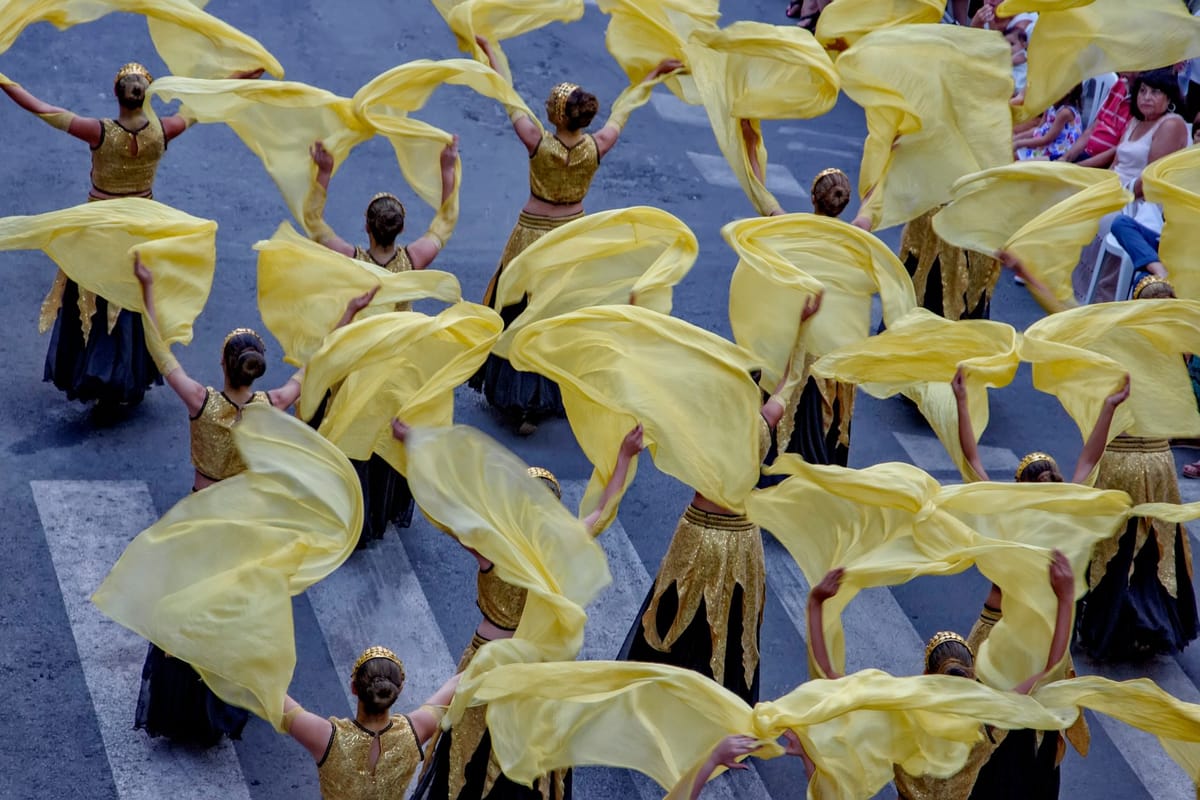
On the Costa Blanca, dance lives first in the street, during the fiestas: the Moros y Cristianos parades of Alcoy and Villajoyosa are genuine collective choreographies, marching in step to dozens of brass bands. Alongside this popular festival tradition, Alicante province also has a real stage history: a past glory, the dancer Antonio Gades from Elda; a recognised choreographer still active, Asun Noales; a creation festival, Abril en Danza; and one of Spain's six public advanced dance schools, in Alicante.
Why does festival dance carry so much weight here?
Because on the Costa Blanca, the great popular choreographic spectacle is the Moros y Cristianos. This has nothing to do with human towers: here we are talking about parades choreographed to the millimetre, where hundreds of festeros march in rhythm, shoulder to shoulder, to the music. In Alcoy, whose current festivities date back to 1817, 28 comparsas (called filaes) share the famous Entrada parade. In Villajoyosa (La Vila Joiosa), where the tradition dates back to 29 July 1538, eleven companies parade in the Moorish and Christian processions on 25-26 July, backed by more than thirty brass bands per parade. The word filà, the line of festeros marching as one, was coined in Alcoy before spreading across the province. The first thing to understand: on the Costa Blanca, the most massive dance is not on a stage, it is in the street, in summer. This festive DNA shows up in other big local events too, from the Hogueras of Alicante to the Misteri d'Elx, the UNESCO-listed sung drama.
On the map: Alcoy, birthplace of the filaes; Villajoyosa, its Moorish and Christian parades in late July.
Is there a traditional dance specific to Alicante?
Yes: the Dansà d'Alacant, a popular street dance specific to the comarques of Alicante (the Alacantí, Alcoià, Marina Alta and Marina Baixa, Vinalopó and Vega Baja). It is danced to the dolçaina (a local reed instrument) and the tabal (drum), and used to be performed around the fire during the fiestas. Careful not to confuse it with the muixeranga and its human towers, which belong to the Valencia region (Algemesí): here there are no human castles, but couple and round dances. This repertoire was revived from 1981 by the Grup de Danses Cresol, in Alicante, which brought back pieces such as the Jota Coliveria, the Jota de Sella, the Ball de l'u and the Seguidilles.
Who is Alicante's great dance figure?
Antonio Gades, real name Antonio Esteve Ródenas, born on 14 November 1936 in Elda, in Alicante province, died on 20 July 2004 in Madrid. Trained under the great Pilar López, he became one of the greatest renovators of flamenco and Spanish dance in the 20th century. The wider public knows him mainly for his film trilogy with the director Carlos Saura: Bodas de Sangre, Carmen and El amor brujo, where his spare, powerful dancing style marked a whole generation. A glory born on the Costa Blanca, whose legacy is now carried by a foundation bearing his name.
And on the contemporary creation side?
The reference figure, very much alive, is Asun Noales Alpañez, born on 17 March 1972 in Elche. A dancer and choreographer, she founded and directs the contemporary dance company OtraDanza, based at L'Escorxador (the CCE) in Elche. Since 2012 she has also directed the Abril en Danza dance festival. To be honest: the province does not, to date, have a 100% Alicante-based contemporary dance festival with the prestige of those in the major capitals, and Abril en Danza spans several cities. But it is the event to know for seeing today's dance creation close to home.
What is the Abril en Danza festival?
The big contemporary dance event of the southern region, spread across Alicante, Elche and Murcia. It is organised by the OtraDanza company, together with the Alicante and Elche town councils and the Teatro Principal de Alicante. Its 15th edition runs from 20 April to 3 May 2026, with 31 activities on the programme: 13 indoor shows, plus workshops and professional meetings. A highlight to note: the La Terreta Balla segment, on 3 May, specifically brings together dancers and choreographers from Alicante province. If you want to discover local contemporary dance in one evening, that is the date to circle.
| Event | Genre | When / key facts |
|---|---|---|
| Moros y Cristianos of Alcoy | Festival parades (popular fiesta) | Festivities dating back to 1817; 28 comparsas, the Entrada parade |
| Moros y Cristianos of Villajoyosa | Festival parades (popular fiesta) | Tradition since 1538; Moorish and Christian processions 25-26 July, 30+ brass bands per parade |
| Dansà d'Alacant (Grup de Danses Cresol) | Traditional street dance | Repertoire revived since 1981, dolçaina and tabal |
| Abril en Danza | Contemporary dance (creation) | 15th edition, 20 April to 3 May 2026; La Terreta Balla segment on 3 May |
| Alicante Dance Festival | Sport dance (ballroom/Latin, WDSF) | 3rd edition, 9-12 October 2026 |
Where can you learn dance at the highest level?
At the Conservatorio Superior de Danza de Alicante (CSDA), a public advanced school that opened in 2002-2003 and is part of ISEACV (the Comunitat Valenciana's advanced arts education institute). It is a rare place: there are only six public advanced dance schools in Spain (Alicante, Barcelona, Bilbao, Madrid, Málaga and Valencia), and Alicante is one of them. Its speciality is dance pedagogy, that is, training tomorrow's teachers. For the city, that is an asset: few provinces can claim an institution of this calibre.
What if I'm looking for dance to watch the rest of the year?
A word on a different kind of event: the Alicante Dance Festival, whose 3rd edition is announced for 9-12 October 2026. Note that this is not creative dance but competitive sport dance (ballroom and Latin, under the WDSF). The organisers present Alicante as "Spain's dance capital" on those days. It has nothing to do with Abril en Danza, but if you like ballroom and Latin dance, that is the moment.
In brief
- The fiesta: the Moros y Cristianos of Alcoy (since 1817, 28 comparsas) and Villajoyosa (since 1538, parades on 25-26 July), the most massive dance in the province.
- The tradition: the Dansà d'Alacant, dolçaina and tabal, revived since 1981 by the Grup de Danses Cresol.
- The glory: Antonio Gades (Elda, 1936-2004), renovator of flamenco, the Carlos Saura trilogy.
- The creation: Asun Noales (Elche, 1972), the OtraDanza company, and her Abril en Danza festival (15th edition, 20 April to 3 May 2026).
- The school: the Conservatorio Superior de Danza de Alicante, one of Spain's six public advanced schools.
Frequently asked questions
Who is the most famous dancer from the Costa Blanca?
Antonio Gades, born in Elda (Alicante) in 1936, died in Madrid in 2004. A great renovator of flamenco and Spanish dance, world-famous for his film trilogy with Carlos Saura: Bodas de Sangre, Carmen and El amor brujo.
Where can you see dance during the fiestas?
In the Moros y Cristianos parades, the province's great choreographic festival. Alcoy (festivities dating to 1817) and Villajoyosa (tradition since 1538, parades on 25-26 July with more than 30 brass bands per procession) are the most spectacular events.
When does the Abril en Danza festival take place?
In spring. Its 15th edition runs from 20 April to 3 May 2026, across Alicante, Elche and Murcia. It is the event for local contemporary dance, directed by the choreographer Asun Noales. The La Terreta Balla segment, on 3 May, highlights artists from the province.
Can you study dance at an advanced level on the Costa Blanca?
Yes, at the Conservatorio Superior de Danza de Alicante, which opened in 2002-2003. It is one of Spain's six public advanced dance schools, specialising in dance pedagogy.
Sources
Biblioteca Virtual Miguel de Cervantes and Grup de Danses Cresol (Dansà d'Alacant); Villajoyosa town council, Biblioteca Virtual Miguel de Cervantes and España en Fiestas (Moros y Cristianos, Alcoy and Villajoyosa); Fundación Antonio Gades, Wikipedia and deflamenco.com (Antonio Gades); Wikipedia and otradanza.es (Asun Noales, OtraDanza); alicante.es, elche.es and abrilendanza.es (Abril en Danza festival); csdalicante.com and portal.edu.gva.es (Conservatorio Superior de Danza de Alicante). Consulted July 2026.
Information verified in July 2026. The Daily Costa Blanca is an AI-assisted publication with human editorial review and responsibility.
Le Livre blanc 2026 de l'expat
NIE, empadronamiento, fiscalité, école, logement : tout l'essentiel pour s'installer, réuni dans un guide PDF. Laisse ton e-mail, on te l'envoie.
🎉 Et voilà ! Ton Livre blanc 2026 de l'expat s'ouvre ici :
Ouvrir le Livre blanc 2026Dernière étape pour rejoindre l'aventure : confirme ton inscription dans l'e-mail qu'on vient de t'envoyer.
Réagis à cet article