
Where to cycle in the Valencia region? Climbs, greenways and loops
Guide updated on 8 July 2026.
The Valencia region is one of the best places in Spain to ride a bike, and not only around the city: you will find flat greenways for easy family outings, legendary Costa Blanca climbs where pro teams spend the winter, and hundreds of kilometres of gravel tracks. Whether you want a one-hour spin or a big 150 km day, alone or in a grupeta, here is where to go. For rides starting from the city itself, we have a dedicated guide to road cycling around Valencia; here, we open up to the whole region.
Where can you ride in the Valencia region?
There are three big playgrounds, depending on your level and mood. The greenways (former railway lines, flat and car-free) are ideal for beginners or family rides. The Costa Blanca, around Calpe and the Marina, concentrates the great climbs for stronger riders. And the Albufera plain and the massifs near Valencia offer easy loops and gravel a stone's throw from the city. Let us take them one by one.
Which big climbs are there for stronger riders?
The finest climbs are in the hinterland of the Costa Blanca, in Alicante province. You can ride them all year thanks to the mild climate. Here are the classics (figures vary a little by source and starting point).
| Climb | Start | Distance | Ascent | Avg gradient | Map |
|---|---|---|---|---|---|
| Alto de Aitana (highest in the region) | From Sella / Benidorm | ~22 km | ~1,230 m | ~6% (hors catégorie) | View |
| Coll de Rates (the legend) | Parcent | 6.5 km | 351 m | 5.4% | View |
| Cumbre del Sol (the wall) | El Poble Nou de Benitatxell | 6.5 km | 391 m | 6% (ramps >15%) | View |
| Puerto de Tudons | Sella | 15.3 km | ~760 m | ~5% | View |
| Alto de Confrides | Benilloba | ~9 km | ~450 m | ~5% | View |
| Guadalest (the gentlest) | Callosa d'en Sarrià | ~6 km | ~510 m | 4.7% | View |
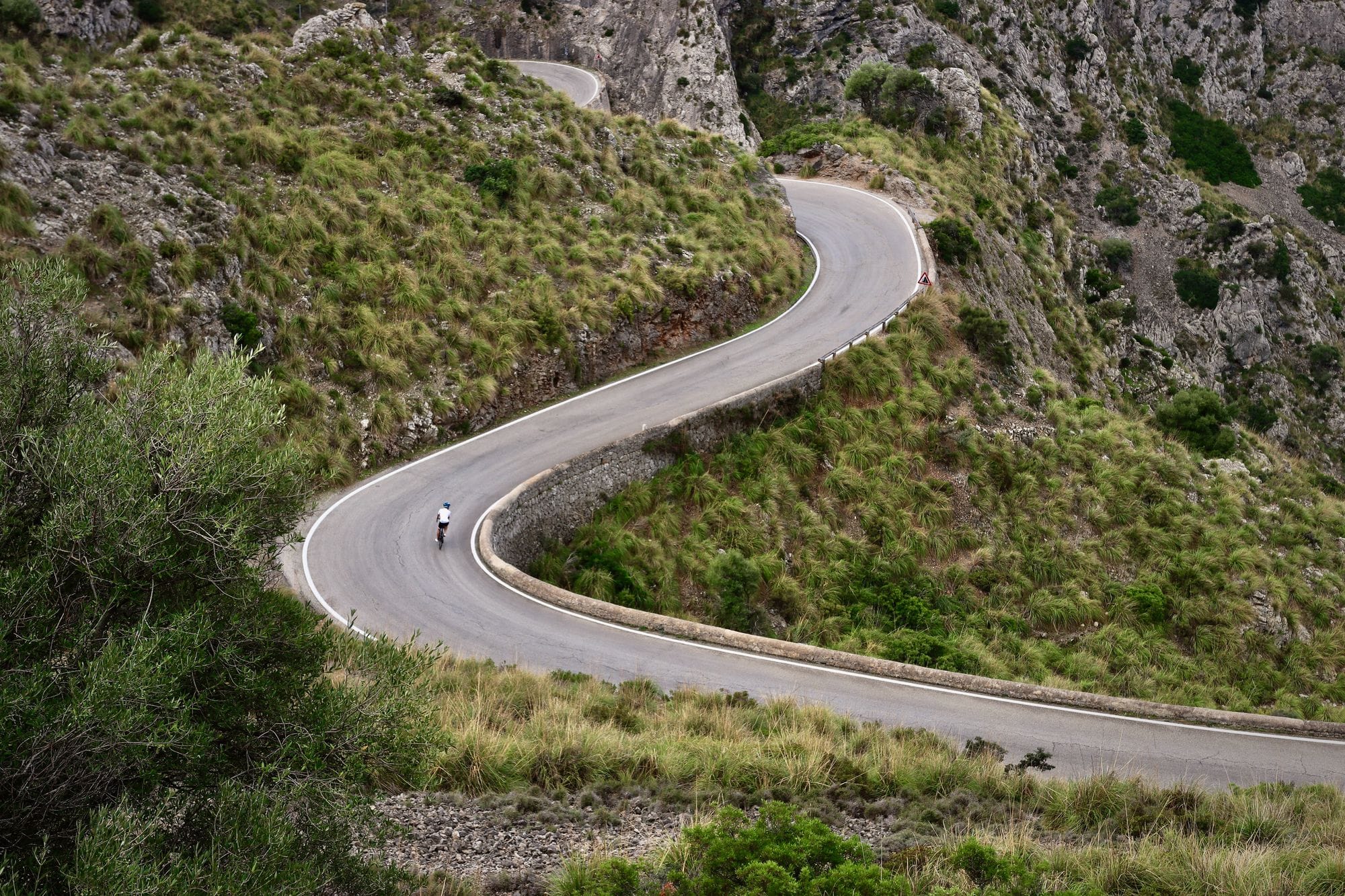
The one to tick off is the Alto de Aitana, the highest road in the Valencia region (about 1,558 m) and an hors-catégorie climb of more than 22 km. The Vuelta a España in fact returns there in 2026 for a summit finish (stage 9, on 30 August, from La Vila Joiosa to Aitana), after an absence since 2016. One caveat: the true high point holds a military base and is off-limits, so you ride up to the last permitted section. The most iconic remains the Coll de Rates, short and flowing, with its panoramic café at the top where every pro turns up in winter. And for pain, the Cumbre del Sol at Benitatxell, a wall with ramps beyond 15%, where the Vuelta finished a stage in 2015.
Which greenways for a car-free family ride?
Greenways follow former railway lines: flat or gently sloped, traffic-free, and often as good for gravel as for children's bikes. The region has several, including the longest in Spain.
| Greenway | Route | Length | For whom | Map |
|---|---|---|---|---|
| Ojos Negros (longest in Spain) | From Barracas towards Sagunto, along the río Palancia | ~83 km (Valencian section) | Gravel, MTB, big rides | View |
| Vía Verde del Serpis | From Muro d'Alcoi to Gandia, through the Racó del Duc | ~40 km | Gravel, families; a stunning gorge | View |
| Vía Verde de Alcoi | From Alcoi towards Ibi, in the Font Roja | ~20 km | Lit tunnels, great viaducts | View |
| Vía Verde del Maigmó | From Agost to the Puerto del Maigmó | ~22 km | 6 unlit tunnels (bring a light) | View |
| Vía Xurra | From Valencia to Puçol, through the Horta Nord | ~16 km | Totally flat, families, orange groves | View |
| Vía Verde de Dénia | From Dénia to Els Poblets | ~6.5 km | Very short, families, Marina Alta | View |
Two favourites. The Vía Verde de Ojos Negros is the longest in Spain: its Valencian section drops about 83 km from the Barracas plateau down to the orange groves near Sagunto, on a gentle grade over a mix of asphalt and packed gravel, perfect on a gravel bike. And the Vía Verde del Serpis crosses the Racó del Duc, a superb gorge between l'Orxa and Vilallonga: the finest stretch (around fifteen kilometres) is easy enough for families. The Vía Verde de Alcoi, for its part, impresses with lit tunnels and the Set Llunes viaduct (230 m long, 46 m high).
Which easy loops start from Valencia?
Two classics, both flat and largely on cycle path. The loop around the Albufera heads south of the city through rice paddies, the Saler pine woods and the fishing village of El Palmar (reckon on 35 km out and back to El Saler, up to nearly 60 km for the full loop). The Turia garden, in the old riverbed, crosses the whole city without a single red light over about 9 km of park, extended by a continuous path to the sea. As these city routes deserve their own guide, we cover them in detail (distances, profiles, local know-how) in our piece on road cycling around Valencia.
Where can you rent a bike, and is Valenbisi worth it?
For getting around town, yes; for sporty rides, no. Valenbisi, Valencia's bike-share, has around 276 stations and 2,750 bikes, with an annual pass at about €29.21 and the first 30 minutes free on each trip. It is unbeatable for city hops, but these are heavy bikes, not made for a 50 km ride. For road, gravel or a day in the climbs, go through a specialist rental shop: you will find them in Valencia, but also in El Saler, Dénia and above all Calpe, the cycling capital of the coast.
Why do the pros train in Calpe?
Because everything lines up for winter riding. The Costa Blanca climate is among the mildest in Europe, with over 300 days of sunshine a year and temperatures often around 15 to 20 °C in winter. The roads are well maintained, and above all the climbs start almost as soon as you leave the seafront: within a 20 to 50 km radius you can link Coll de Rates, Tudons, Aitana or Confrides. Add hotels built for cyclists and prices friendlier than Girona or Tenerife, and you see why World Tour team buses fill the car parks of Calpe every winter.
Gravel and MTB: where to leave the tarmac?
Two nearby massifs are especially good for gravel and mountain biking. The Serra Calderona, north of Valencia, offers a network of forest tracks with the Garbí viewpoint (601 m) and the high point El Gorgo (907 m); a popular start is the Pla de Lucas area in Náquera. Important: inside the park, bikes are allowed only on forest tracks (not on mountain footpaths), walkers have priority and speed is capped at 30 km/h. Further north, the Sierra de Espadán and its cork-oak forests unroll fine gravel loops around Eslida and Aín, in one of the region's best-preserved areas.
Riding solo or in a group: where to find a ride?
Riding alone is great for going at your own pace, but the region has a real grupeta culture, and there is a group for every level. The Peña Ciclista Excursionista de Valencia is one of Spain's few century-old cycling clubs, a fine piece of local heritage. The Peña Ciclista of the CDUPV (Polytechnic University) runs rides by clearly posted levels, from G1 (100 to 130 km at 20-25 km/h) to G4 (over 140 km at a brisk pace), so anyone can find their place. To find a club near you, the Valencian Cycling Federation (fccv.es) keeps the official directory by town and discipline.
What does the law say about riding safely?
A few Spanish rules to know before heading out. The helmet is mandatory outside towns for all cyclists (recommended in the city, mandatory for minors everywhere). Note that the rules are tightening: on 1 October 2026, a reform (RD 518/2026) removes the last exemptions to wearing a helmet outside towns (going without becomes a serious offence, €200 fine) and requires cars, on top of the 1.5 m side clearance already mandatory to pass a cyclist, to cut their speed by at least 20 km/h when overtaking. At night or in poor visibility outside towns, a white front light, a red rear light and a reflective vest are required.
The rest is local common sense. In summer the real danger is heat: set off early, avoid the middle of the day (noon to 6 p.m.), hydrate continuously with electrolytes, and do not forget sunscreen. In case of an accident or heatstroke, the single emergency number is 112, with multilingual operators. To plan your trips and mix bike and public transport in the city, we explain it all in our guide to getting around Valencia.
In short
- The climb to tick off: the Alto de Aitana, the region's highest road (~1,558 m), on the Vuelta 2026 route.
- For families: the greenways, including Ojos Negros (the longest in Spain) and the Serpis through the Racó del Duc.
- Flat near Valencia: the Albufera loop and the Turia garden, almost entirely on cycle path.
- In a group: clubs and peñas for every level (Peña Excursionista, CDUPV); directory on fccv.es.
- Law: helmet mandatory outside towns, 1.5 m to overtake; new rules from 1 October 2026 (RD 518/2026).
Frequently asked questions
What is the highest rideable climb in the Valencia region?
The Alto de Aitana, at about 1,558 m, in the Costa Blanca hinterland. It is an hors-catégorie climb of over 22 km. The true summit, occupied by a military base, is off-limits: you ride to the last permitted section.
Which greenway should you pick for a family ride?
The Vía Xurra (16 flat km from Valencia to Puçol) for a short outing, or the Racó del Duc stretch of the Vía Verde del Serpis for a spectacular, easy setting. Ojos Negros suits bigger gravel rides.
Is a helmet mandatory when cycling in Spain?
Yes outside towns for everyone, and everywhere for minors. On 1 October 2026 a reform removes the last exemptions outside towns and requires cars to slow by at least 20 km/h to overtake.
Why do professional cyclists go to Calpe?
For its very mild climate (over 300 days of sun), well-kept roads and climbs that start right at the seafront, all at a friendlier cost than other European training bases.
Can you use a bike-share bike for a big ride?
No: Valenbisi (annual pass around €29.21, first 30 minutes free) is perfect in town but its bikes are too heavy for sport. For a road or gravel outing, rent a proper bike from a specialist.
Fancy swapping the handlebars for hiking boots? Discover our guide on where to hike in the Valencia region, with the ranges, waterfalls and refuges. And for rides starting from the city, head to road cycling around Valencia.
Le Livre blanc de l'expat à Valencia
NIE, empadronamiento, fiscalité, école, logement : tout l'essentiel pour s'installer, réuni dans un guide PDF. Laisse ton e-mail, on te l'envoie.
🎉 Et voilà ! Ton Livre blanc de l'expat s'ouvre ici :
Ouvrir le Livre blancDernière étape pour rejoindre l'aventure : confirme ton inscription dans l'e-mail qu'on vient de t'envoyer.